SaaS Sprawl Is a Tax on Growth: How Enterprise Software Consolidation Funds Your AI Roadmap

Enterprise software sprawl is no longer an IT inconvenience. It is a direct tax on growth.
Every fragmented SaaS subscription creates four costs:
- License expense.
- Integration overhead.
- Data fragmentation.
- Technical debt.
The invoice shows only the first.
The other three appear in delayed reporting, duplicate records, manual reconciliation, security exposure, and stalled automation. Finance pays for software. Operations pays for friction. IT pays for complexity. The enterprise pays everywhere.
AI makes this problem fatal.
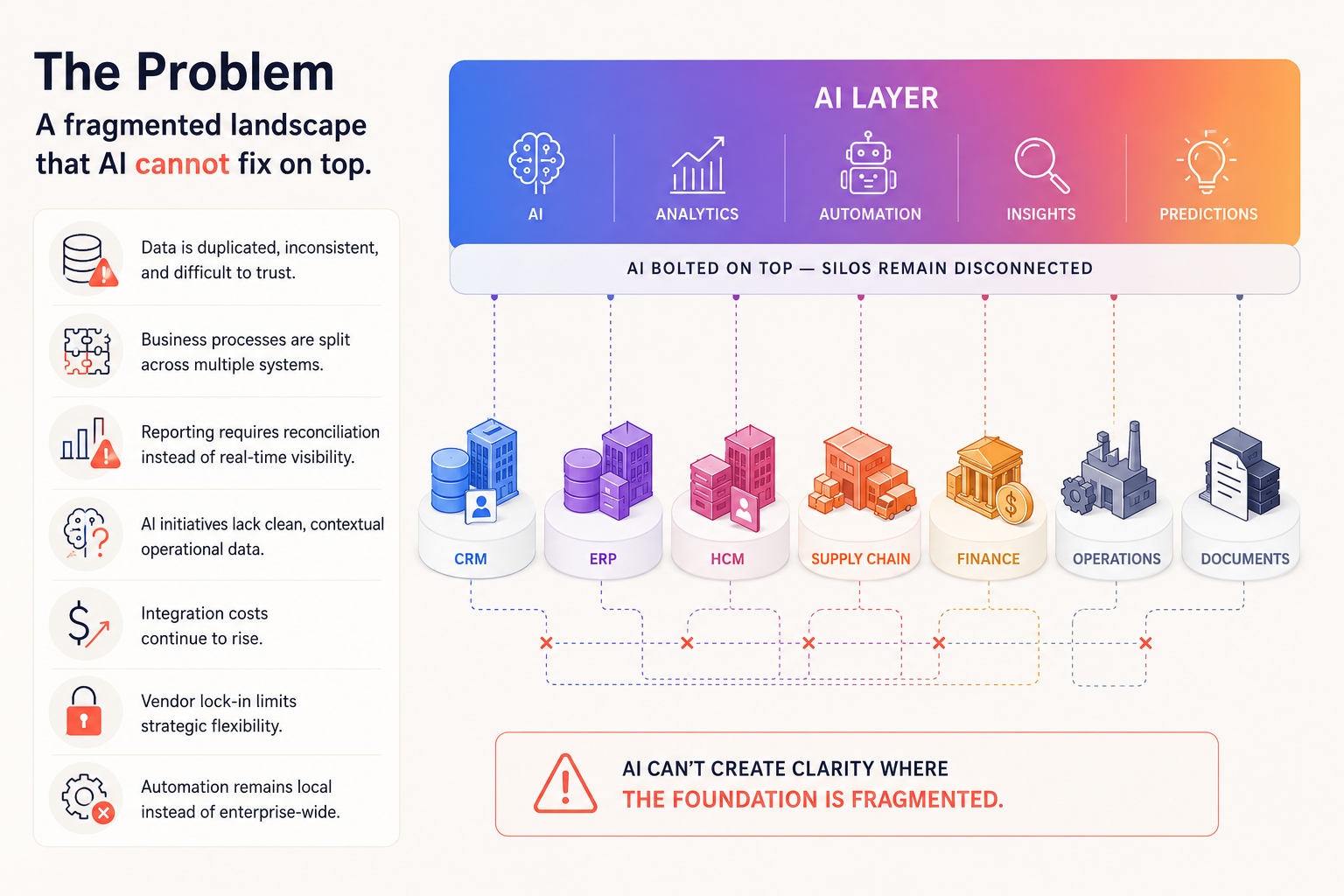
AI cannot create reliable enterprise intelligence from disconnected systems. It cannot reason across duplicated data, fragmented workflows, and inconsistent permissions. Adding an AI assistant to every existing application does not solve the operating model. It creates another layer of fragmentation.
The answer is not more software.
The answer is disciplined SaaS sprawl reduction, decisive enterprise software consolidation, and a unified data platform that turns technology spend into reusable operating infrastructure.
Insight 01: SaaS sprawl is an operating tax, not a procurement problem
Most application portfolios were never designed. They accumulated.
A department needed a capability. Someone purchased a tool. Another team purchased a similar tool. Integration followed. Data duplicated. Users created workarounds. The business accepted the complexity because each decision appeared rational in isolation.
The portfolio became irrational as a whole.
This is the core failure. Enterprise leaders review individual renewals instead of the operating system created by the entire portfolio.
The true cost of a SaaS application includes:
- Annual licenses and premium add-ons.
- Implementation and configuration.
- Integration development and maintenance.
- User administration and access management.
- Data synchronization and reconciliation.
- Security and compliance review.
- Training and change management.
- Reporting across inconsistent systems.
- Exit costs when the business finally retires the tool.
A $100,000 subscription can generate several times that amount in operating obligations.
This is why SaaS sprawl reduction must begin with economics. The question is not, “Does this application have users?”
The question is, “Does this application create enough differentiated value to justify its total operating cost?”
That is a CFO question. It is also a CIO question.
Insight 02: AI exposes the weakness of fragmented architecture
Traditional automation could survive fragmentation.
A team could automate one step inside one system. The result looked productive. The enterprise still carried the underlying handoffs, duplicate records, and disconnected decisions.
AI changes the standard.
AI depends on context. Context depends on connected data. Connected data depends on shared models, governed access, and coherent workflows.
A fragmented application estate breaks the chain.
The agent cannot determine which customer record is authoritative. It cannot trust conflicting financial data. It cannot execute a cross-functional workflow without navigating multiple identity models and brittle integrations. It cannot understand an operational process that exists partly in an ERP, partly in email, partly in spreadsheets, and partly in employee memory.
The enterprise then blames the model.
The model is not the problem. The foundation is.

An AI layer bolted onto fragmented software is technology theatre. It creates activity without creating operating leverage.
An AI-native operating platform does the opposite. It embeds intelligence into the workflows, data structures, controls, and decisions that run the business.
That distinction determines whether AI becomes a growth engine or another cost center.
Insight 03: Rationalize the portfolio with five hard verdicts
Application rationalization requires decisions. Not observations. Not another inventory. Decisions.
WunderHub uses five verdicts to evaluate an application through an AI-era lens:
1. Keep
Keep systems that provide strategic, differentiated value.
The application must have strong adoption, clear ownership, defensible capability, acceptable risk, and a viable role in the future architecture.
“People use it” is not enough. Strategic value must survive financial and architectural scrutiny.
2. Consolidate
Consolidate duplicate capabilities.
Multiple project tools, service platforms, analytics products, collaboration systems, or workflow engines create unnecessary cost and inconsistent data. Select the enterprise standard. Migrate dependent teams. Remove the duplicates.
Consolidation creates immediate savings. It also reduces the number of systems that future AI initiatives must understand.
3. Replace
Replace applications when a stronger enterprise capability already exists.
The replacement may come from an existing strategic platform, a Microsoft capability, an industry operating system, or a unified AI-native platform. The objective is not to preserve historical purchasing decisions. The objective is to establish the best operating foundation for the next decade.
4. Agent-enable
Keep the system of record. Remove the friction around it.
Some applications contain critical transactional history or specialized functionality. Replacing them creates unnecessary risk. Agent-enable them instead.
Use governed agents to handle document processing, approvals, routing, recommendations, exception management, and natural-language access. Preserve the record. Redesign the work.
5. Retire
Retire applications that no longer create sufficient value.
Low usage, high cost, redundant capability, weak controls, and poor data quality are retirement signals. Sentiment is not a business case. Legacy status is not a strategic exemption.
Every retirement should include a migration plan, an owner, a decommission date, and a measured benefit.
The verdict is simple. Keep, Consolidate, Replace, Agent-enable, or Retire.
Anything else is delay.
Read the full AI Application Rationalization framework.
Insight 04: Consolidation funds the AI roadmap
AI programs fail when leaders treat them as additional spending.
The CFO sees rising license costs, consulting fees, cloud consumption, and internal labor. The board sees pilots without measurable returns. The CIO sees more integration, more governance, and more security exposure.
The AI roadmap becomes vulnerable before it reaches production.
Enterprise software consolidation changes the funding model.
Retiring duplicate applications releases license expense. Removing middleware reduces maintenance. Standardizing workflows reduces manual reconciliation. Centralizing data reduces reporting labor. Consolidating contracts improves procurement leverage.
The released capacity funds higher-value AI work.
This is the financial logic:
- Establish the current application and operating baseline.
- Identify duplicate functionality and unnecessary integrations.
- Assign each application one of the five rationalization verdicts.
- Quantify license, labor, integration, risk, and transition costs.
- Capture savings through contract action and decommissioning.
- Reinvest the realized value into governed AI capabilities.
This is not cost cutting for its own sake.
It is capital reallocation from fragmented rental expense to owned enterprise capability.
WunderHub’s AI Value Realization Sprint uses this same discipline. It ties AI investment to revenue, cost, capacity, cycle time, risk, customer experience, and decision quality.
AI activity is not value. A deployed license is not value. A pilot is not value.
Value appears when the workflow changes and the baseline improves.
Insight 05: The unified data platform becomes the enterprise control point
Consolidation without data architecture creates a cleaner mess.
The enterprise needs a unified data platform that establishes trusted records, shared semantic models, governed documents, transactional context, and consistent access controls.
This does not mean forcing every workload into one database. It means creating one operating foundation for how data is defined, connected, governed, and used.
The foundation must answer basic questions with precision:
- Which system owns the customer record?
- Which data defines revenue?
- Which workflow controls approval?
- Who can access sensitive information?
- Which agent can act?
- Where does human approval remain mandatory?
- How does the organization measure output quality?
Without these answers, AI produces confident inconsistency.
OrgOS™ positions the Unified Operational Data Foundation as the core of AI readiness. It connects people, work, customers, finance, content, assets, and intelligence into one operating model.
That architecture creates compounding returns.
Each new workflow benefits from the same data foundation. Each new agent benefits from the same identity and governance model. Each new insight benefits from the same operational context.
The cost of the next AI capability declines because the enterprise stops rebuilding the foundation.
Insight 06: Five value pillars determine whether consolidation creates results
Enterprise software consolidation must connect to an operating model. Five value pillars make that connection explicit.
Value
Start with a measurable baseline.
Track cost, capacity, cycle time, risk, revenue, and service quality. Fund initiatives that change the baseline. Stop initiatives that do not.
Workflows
Redesign the work.
Automation applied to a broken process creates faster dysfunction. Define what humans should own, what agents should reason through, what automation should execute, and where exceptions require judgment.
Agents
Put governed agents inside real operations.
Agents must have defined responsibilities, access boundaries, escalation rules, owners, and performance measures. An agent without governance is an uncontrolled employee with system access.
Governance
Control the lifecycle.
Governance covers identity, permissions, data boundaries, evaluation, monitoring, incident response, approval thresholds, and retirement. Build it before deployment. Do not wait for an audit or failure.
Foundation
Build reusable architecture.
Trusted data, semantic models, shared knowledge, workflow services, and reference architecture make every subsequent AI investment faster and cheaper.
These pillars are not presentation language. They are operating requirements.
WunderHub’s AI-native operating model connects them into an execution framework.
Insight 07: The end state is owned intelligence
The goal is not to own fewer applications.
The goal is to own a more intelligent enterprise.
A consolidated operating platform should give executives a unified view of performance. It should connect decisions to workflows. It should make data available in context. It should allow governed agents to act across functions. It should reduce dependence on manual coordination and vendor-specific silos.
That is the purpose of OrgOS™.
It is not another point solution. It is an operating foundation for integrating people, data, workflows, intelligence, and decisions. Organizations can use standalone products, replace legacy platforms, or build a unified AI platform around the framework.
The strategic choice is clear:
- Point solutions rent isolated capabilities.
- Consolidated platforms build reusable infrastructure.
- AI-added tools improve tasks.
- AI-first operating models improve how the enterprise works.
- Fragmentation multiplies cost.
- Unity compounds intelligence.
The enterprise technology model has reached its breaking point. More subscriptions will not repair it. More integrations will not simplify it. More AI pilots will not create value on top of disconnected operations.
Start with the portfolio. Apply the five verdicts. Build the unified data platform. Reinvest the savings.
Stop treating SaaS sprawl as a procurement leak.
Treat it as the funding source for your AI roadmap. Build the operating foundation your enterprise will own, govern, and compound.